Education video production can open a rehearsal room to schools, explain classroom research or give staff training they can revisit. The learning objective comes first. We then plan recorded filming, live streaming or a combination around the audience and the way they need to participate.
Imagine being a pupil studying Romeo and Juliet and suddenly finding yourself inside the Royal Shakespeare Company’s rehearsal room. The actors have only just begun working on the scene. The director interrupts, asks them to try a different emotional choice and thousands of classrooms can watch that decision change the performance.
That sense of access sits at the heart of our live learning work. The RSC Live Lesson brought 17,000 pupils into a working rehearsal. Festival of Learning gave award recipients and their stories an audience beyond the room. Smartphone video workshops let staff learn by making a film themselves. The projects shared one human promise: help people feel present, involved and able to use what they had learned.
The production still needed cameras, graphics, accessible outputs, remote contribution and resilient streaming. Those systems protected the learning experience and kept the technology in service of it.
Opening the RSC rehearsal room to pupils
On 25 January 2018, the Royal Shakespeare Company streamed its first Live Lesson directly from the Romeo and Juliet rehearsal room. Presenter Georgia Munnion joined Deputy Artistic Director Erica Whyman and actors Bally Gill and Karen Fishwick to explore the balcony scene while the production was still developing.
The value lay in access to the creative process. Pupils could watch a director and actors discuss, test and refine choices. The programme made rehearsal itself visible and opened the developing work to classrooms.
We were commissioned by the RSC to produce the complete livestream, excluding the editorial writing of the lesson. Cameras, live direction, graphics and presentation had to work inside a rehearsal environment without overwhelming the process being shared.
The RSC recorded an audience of 17,000 pupils. Questions and comments arriving through Twitter connected classrooms with the people in the room, turning the broadcast into a live exchange. Afterwards, teachers described pupils discovering new depth in the language and being drawn into the characters by watching the director interrupt, question and reshape the scene.
RSC Faith: five remote streams across Coventry
The later Faith project required a different educational and cultural workflow. Produced during Coventry City of Culture, Faith unfolded as a promenade experience across the city. We delivered five consecutive programme masters in one day from remote locations.
The production included multiple accessibility outputs, including captions, British Sign Language and audio description. Remote contribution, camera feeds, communications, monitoring and redundancy had to work across the entire moving programme.
Six weeks of testing supported the final day. The production team spent around 12 hours on foot, and the moving audience numbered approximately 600. The technical system had to remain dependable while performers, crew and audiences moved through Coventry.
This project shows that accessibility is part of production design. Captions, BSL and audio description influence monitoring, layouts, timing and delivery. They work best when planned as programme outputs from the start.
Festival of Learning: celebrating achievement beyond the venue
Festival of Learning is a long running awards programme from Learning and Work Institute. Our work spans several editions, from 2018 until 2024 and the first Get the Nation Learning Awards in 2025.
For the 2022 production, we combined venue AV, lighting, in house cameras, a livestream, remote contribution, graphics, video playback and multiple programme recordings. The event needed to celebrate award recipients in the room while allowing a wider audience to join online.
Awards production has a learning role of its own. Films, interviews and presentations explain why each person or programme matters. The broadcast must preserve the emotional impact of recognition while keeping names, categories, graphics and remote elements accurate.
A repeat relationship also allows the technical workflow to evolve across editions. The production can respond to a new venue, programme or audience without starting from zero.
Practical skills through corporate training
Live learning projects can also serve focused groups. Our smartphone video training for Jaguar Land Rover and Land Rover Experience staff developed practical skills that participants could use immediately.
Two one day workshops took place in Birmingham and Liverpool in September 2013. Producer and Director Jay Rozanski and Senior Video Editor Simon Rodman guided participants through story planning, framing, sound, coverage and editing. Staff used accessible devices and consumer tools, then made their own film, The Unruffled Hero, as proof of learning.
The workshop followed a real production sequence. Participants moved from an idea to recorded material and then to an edited result. That structure made the training active: people learned by making decisions and seeing their effect on screen.
The same principle informs multi site corporate training programmes. Live or recorded delivery is most useful when it gives participants a clear task, a route to ask questions and material they can revisit afterwards.
What successful live learning requires
The strongest educational broadcasts share several characteristics.
They begin with a clear learning objective. The RSC wanted pupils to understand rehearsal choices. Festival of Learning wanted to celebrate and explain achievement. The JLR workshops wanted staff to make better films with tools already available.
They create participation. Questions, remote contributors, practical exercises and audience responses prevent the production from becoming a one way lecture.
They make content readable. Camera positions, graphics, sound and pacing should help the viewer follow the subject. Production choices must serve the lesson.
They plan accessibility and resilience early. When people depend on a stream to take part, captions, BSL, audio description, monitoring and backup routes are core programme requirements.
Production designed around people
Educational and training clients are asking an audience to concentrate, learn and participate. A professional production demonstrates respect for that commitment.
Our work across theatre, awards and workplace learning shows an ability to build the technical workflow around the educational purpose. The proof lies in what the signal enabled: pupils could enter an RSC rehearsal, learners could be celebrated beyond the room and staff could leave a workshop with a completed film and a usable process.
The human response matters as much as the technical delivery. Teachers described the RSC lesson as inspiring because pupils could watch professional actors and a director make choices while the work was still developing. That immediacy is the point: the production gives learners access to people, spaces and conversations usually closed to them.
LEGO Education: learning on film
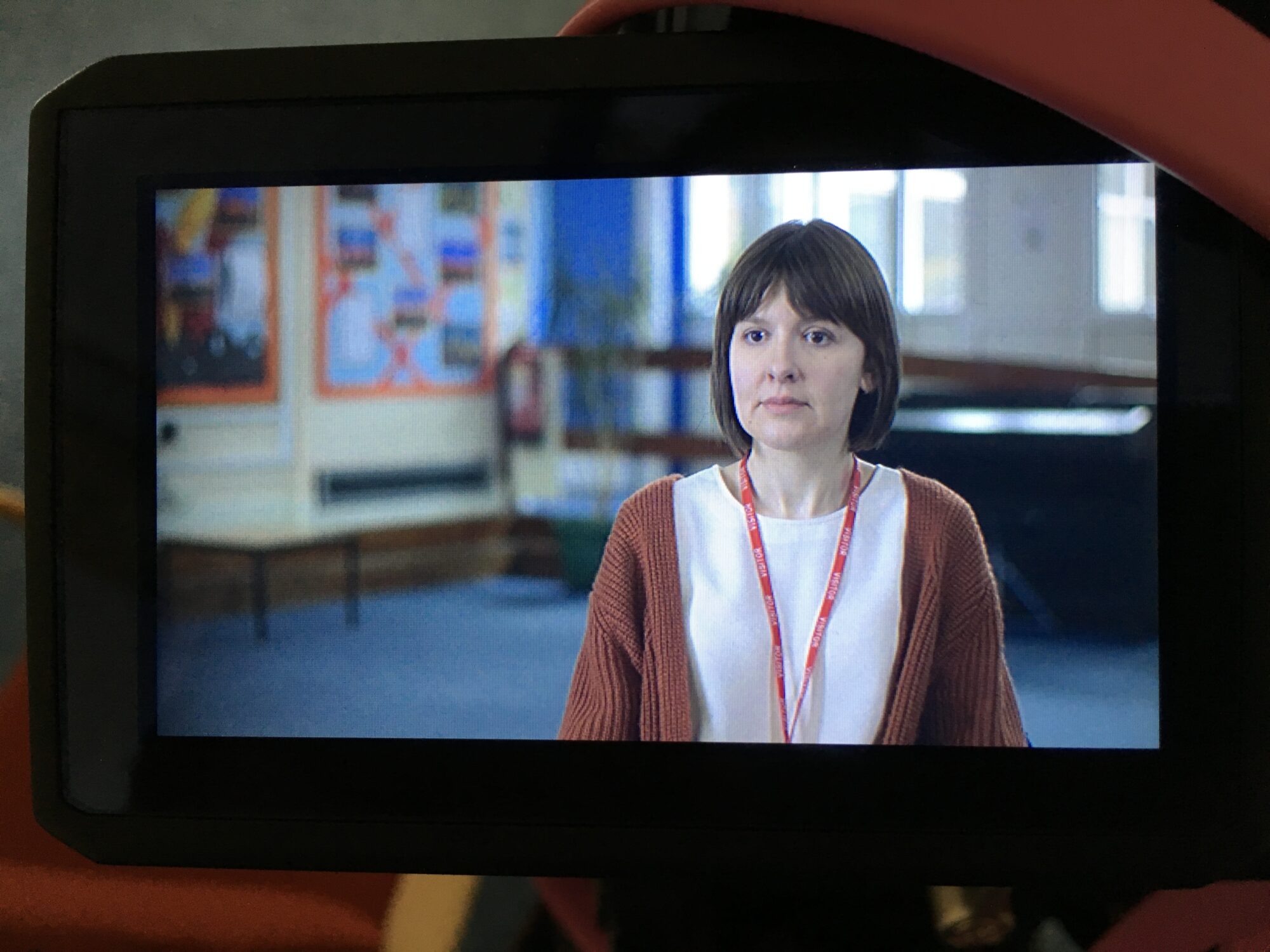
For the LEGO Education StoryStarter research film, we combined teacher interviews with classroom activity at Bar Hill Community Primary School. This was a recorded film, giving us time to shape the explanation and show the learning environment in detail.
Teacher voices and classroom detail gave the research a human context. Explore our LEGO Education film production and the University of Cambridge’s PLaNS research.
Choosing recorded video or live delivery
Recorded films allow you to refine explanations, check accuracy and prepare versions for different audiences. Live delivery creates space for immediate questions and shared participation.
Tell us the learning objective, viewing context, contributor needs and accessibility requirements so we can plan the appropriate format with you.
Explore our education and corporate video production or talk to us about your production.