Remote sports commentary production combines an existing event feed with commentators in other locations. We bring the pictures, commentary, programme sound and delivery routes together so a fight promotion can serve a new language audience.
A fight can take place thousands of miles away. The commentators can be in different countries. The engineering team can be in Sheffield. The English language audience still expects one coherent live programme.
That is the idea behind our developing remote sports commentary workflow. It takes the production experience built through Tankō, VIP Boxing and other live combat sports events and applies it to a different problem: how to localise an existing international programme for English speaking audiences without flying an entire broadcast team around the world.
The result is a practical REMI model for live fight production. Pictures arrive from the host production. Specialist commentators contribute from wherever they are based. We bring the sources together, manage the audio, communications, recording and distribution, and return a finished English language programme to the required destinations.
The next step after venue based boxing production
Tankō and VIP Boxing proved that a repeatable live sports workflow depends on far more than placing cameras around a ring. The production needs planning, editorial awareness, reliable sound, graphics, communications, distribution and a team able to make decisions while the event is moving.
Remote localisation keeps those disciplines and changes the geography.
For recent fight productions originating in Kazakhstan and Ukraine, the host broadcaster already had cameras, directors and programme sound at the venue. Rebuilding that complete operation in another country would add cost and duplicate work. The real need was an English language version that could serve additional audiences and distribution partners.
We designed the missing layer: a remote production hub connecting the international pictures with English speaking commentators and onward destinations.
Relationships are part of the production infrastructure
Some international opportunities begin through trusted relationships built inside the sport. Our engineering and Primary Control Room (PCR) capability is combined with a specialist commentary network that has spent years working inside combat sports and building trust with promotions, commentators and distribution partners.
Those relationships help identify which fight championships could travel to a new audience, open the right conversations and shape a workable offer. The team can consider the promotion, rights position, language, commentators and potential destinations together before engineering a workflow around them.
That collaborative approach has helped bring organisations including NAIZA Fighting Championship in Kazakhstan and BFL Pro in Ukraine towards English speaking audiences. It is also creating routes into the Spanish language market through established commentators and platform relationships.
A live programme can travel while people stay put
The human benefit is simple. The right commentator can join from wherever they are based.
A commentator can contribute from a professional home studio in America. Another can work from Surrey or from a temporary production position while travelling. The incoming fight programme can originate in Almaty, Aktau, Ukraine or another international location. Engineering and quality control remain with our UK master control room.
Everyone sees and hears what they need. The audience receives a unified programme.
That flexibility is particularly valuable in combat sports. Good commentary depends on knowledge of fighters, promotions, records, styles and storylines. Remote production makes it possible to bring the appropriate expertise into the programme without making geography the deciding factor.
How the REMI commentary workflow works
The host production sends its live programme to us using SRT, a transport method designed to carry high quality video over real world internet connections. The incoming feed contains the international pictures and programme sound.
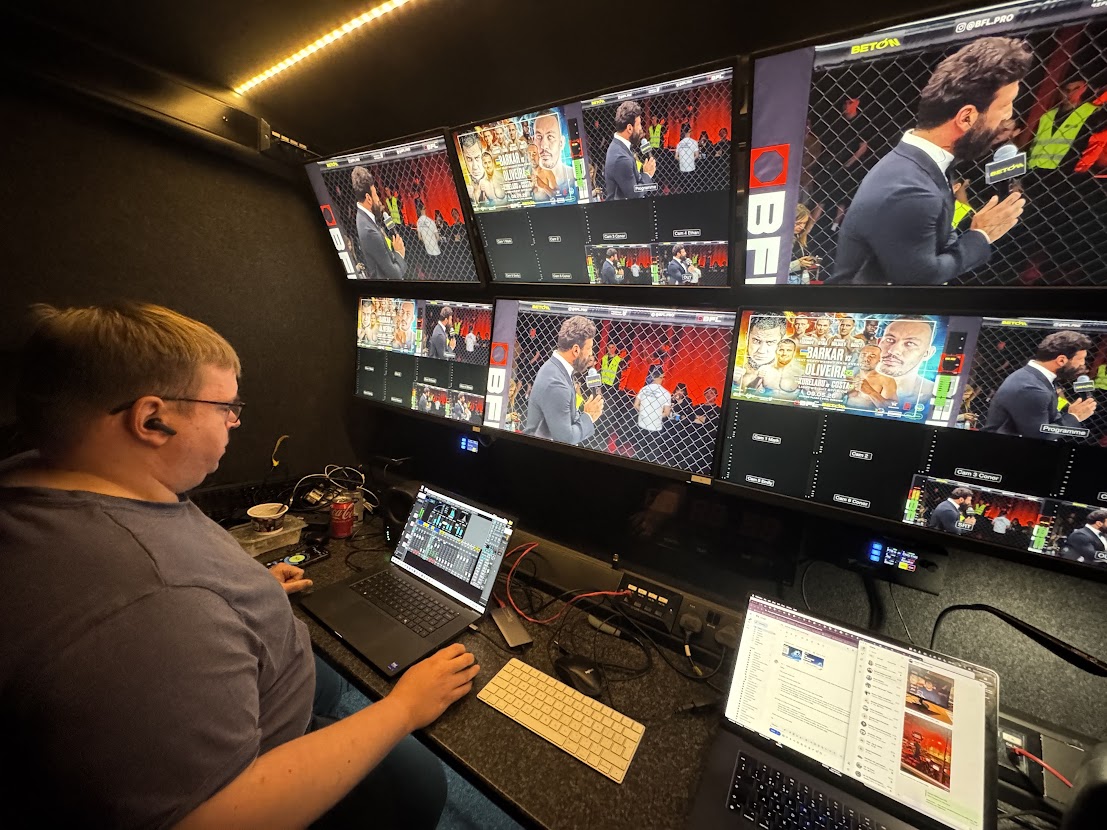
The PCR checks the signal, manages the contribution path and provides the commentators with a monitored return. Each commentator receives the fight pictures and international sound while contributing a clean microphone feed back to the production.
Dedicated communications allow commentators to hear one another and receive engineering or production talkback without putting those conversations on air. Where the locations and equipment support it, managed IP audio and Dante routing keep the programme, commentary and communications paths separate.
Inside the PCR, we add the English commentary to the international programme, monitor the final mix and record both the completed output and useful isolated audio channels. The localised programme can then be delivered by SRT to the approved online or broadcast partners.
The audience experiences a single live show. Behind it sits a carefully coordinated conversation between a venue production, a UK PCR, distributed commentators and receiving platforms.
Localisation is more than translating words
An English language feed should feel like a programme created for its audience, with commentary fully integrated into the pictures and production rhythm.
Commentators need accurate fighter information, pronunciation guidance, a dependable running order and enough programme context to explain what is happening between bouts. Long sections intended for the domestic audience may need additional English presentation or analysis to maintain engagement.
The first productions helped the team identify those editorial opportunities. Technical delivery made the English feed possible; debriefing showed how future versions could become even more audience focused through better pre show information, clearer production cues, replay discussion and carefully planned presenter moments.
This feedback loop is part of the service. Every event creates operational knowledge that improves the next one.
Latency, resilience and choosing the right compromise
Remote live production always involves a balance between immediacy and resilience.
A very small SRT buffer reduces delay, which may be important when commentary must return to a host broadcaster with tight timing. A larger buffer gives the transport more protection against packet loss and variable networks. The correct setting depends on where the English audio is being added, who receives the final programme and what level of delay the distribution chain can accept.
We size the delay around each programme.
The workflow can also include separate monitoring feeds, lower bandwidth confidence paths, local recordings and backup communications. Commentators may have alternative ways to hear the programme or stay in contact if a primary talkback route develops a fault. The PCR records isolated microphones and the finished mix so useful elements remain available after the live transmission.
Resilience comes from a collection of planned alternatives that prevent one local issue from stopping the whole programme.
Why testing matters
The final show can look calm because we have already handled the difficult conversations, tests and contingency decisions beforehand.
Different computers handle audio differently. Home networks vary. Firewalls, routing, virtual audio devices and local permissions can affect a remote booth. International teams work across languages and time zones. Destination details sometimes arrive later than the engineering team would like.
That is why we build tests into the workflow.
A useful test covers the complete path: incoming international feed, commentator monitoring, microphone contribution, co commentator audio, talkback, the English mix, outgoing SRT destinations and recording. It also establishes who makes decisions and how the team communicates if something changes during the event.
The aim is to let the people work together before the opening bell, with every device supporting that shared rehearsal.
From one English feed to a scalable production model
The first Kazakhstan production generated strong feedback from both the promotion and its Pakistan distribution partner. It also proved that the relationships and the technical model could grow together.
A single international source can support more than one localised output when commentary, audio routing and distribution are designed correctly. The English programme has already been delivered to NAIZA’s own platforms, Tamasha in Pakistan and beIN Sports. Each destination received the localised feed it required without the host promotion having to rebuild its venue production.
The same model creates a route towards Spanish language coverage. A separate Spanish commentary team can receive the same pictures and create its own programme, while cloud routing extends the number of destinations without forcing every output through one physical connection.
We are also developing a more repeatable remote commentary unit: a controlled package that can be deployed to an approved commentator, connected to the production and supported remotely. That reduces setup variation and makes it easier to bring new specialists into future events.
The longer term opportunity includes simultaneous productions, English and Spanish outputs, and a wider network of commentators who can be matched to the promotion, audience and time zone. It also creates a route for more fight organisations to enter language markets that may previously have required a costly travelling production team.
Those extensions still require proper planning, testing, rights agreements and realistic production budgets. The important point is that the working foundation and the industry relationships now exist.
Technology that makes expertise available
The most compelling part of remote sports commentary is the access the system creates.
A promotion can take a live event beyond its domestic audience. A distribution partner can receive a programme prepared for a new language market. A specialist commentator can contribute from the place where they work best. The host production retains the pictures it has already created, while we work with our commentary partners to add the relationships, localisation and delivery layer needed to reach another audience.
The proof is already international. English language programmes have been delivered to NAIZA’s own services and to major distribution destinations including Tamasha in Pakistan and beIN Sports. The Spanish language route is being developed through an established Spanish commentary team and relationships with platforms serving Spanish speaking audiences.
This is a natural progression from the repeatable live boxing workflow. Tankō and VIP Boxing showed how a production format could grow an audience over time. International remote commentary shows how that same production discipline can cross borders.
Haivision’s SRT latency guidance explains the relationship between buffering and packet recovery. We test the complete contribution and return route because transport buffering is only one part of the delay a commentator experiences.
For a different live sport setting, see our Westchester Cup polo broadcast, which brought together match coverage, commentary and online delivery.
What we need to plan a remote commentary production
Confirm the host feed specification, languages, commentator locations, event times and approved receiving platforms. The test should include picture returns, microphone sound, talkback, synchronisation and the final output.
Agree who supplies fighter information and editorial cues, and what happens if a commentator loses their connection.
Explore our outside broadcast and remote production support or talk to us about your production.